" Untuk maju kita yang memilih sendiri caranya, abaikan semua yang akan menghalangi langkahmu, percaya keajaiban itu akan ada setelah kerja keras yang bekerja secara maksimal" -uly-
Menurut hukum II Termodinamika, tak mungkin
didapatknan mesin panas yang bekerja
antara dua tandon
panas dengan efisiensi 100
persen. Carnot menemukan bahwa semua mesin reversibel yang bekerja antara dua
tandon panas mempunyai efesiensi yang sama dan bahwa tidak ada mesin yang dapat
mempunyai yang lebih besar daripada
efesiensi mesin reversibel. Hasil inidikenal sebagai teorema Carnot yaitu :
“tidak
ada mesin yang bekerja di antara dua tandon panas yang tersedia yang dapat
lebih efesien daripada mesin reversibel yang bekerja di antara kedua tandon
itu”.
Beberapa syarat yang diperlukan agar proses bersifat reversibel:
1.Tidak
ada energi mekanik yang dapat hilang karena gesekan, gaya viskos, atau gaya disipatif
lain yang menghasilkan panas.
2.Tidak
ada konduksi panas karena beda temperatur.
3.Proses
harus kuasi-statik agar sistem selalu dalam keadaan setimbang (atau sangat
dekat dengan keadaan setimbang).
Tiap proses
yang melanggar salah satu kondisi diatas merupakan proses irriversibel.
Kebanyakan proses yang terjadi di alam bersifat irriversibel.
Carnot, dalam tahun
1824, adalah orang yang pertama kali memperkenalkan suatu proses siklik kedalam
teori termodinamika yang sekarang dikenal sebagai siklus Carnot. Carnot terutama
sekali tertarik di dalam meningkatkan mesin uap. Usaha Carnot ini dapat
dikatakan sebagai landasan pengetahuan tentang termodinamika.
Siklus Carnot dapat dilaksanakan dengan system yang bersifat apapun.
Boleh zat padat, cair atau gas, atau juga saput permikaan (surface film), atau
zat paramagnetic. Bahkan system boleh juga mengalami perubahan fase selama
siklus tersebut. Dan mesin reversibel yang memakai gas ideal sebagai zat kerjanya , dikenal dengan
istilah yaitu siklus Carnot.
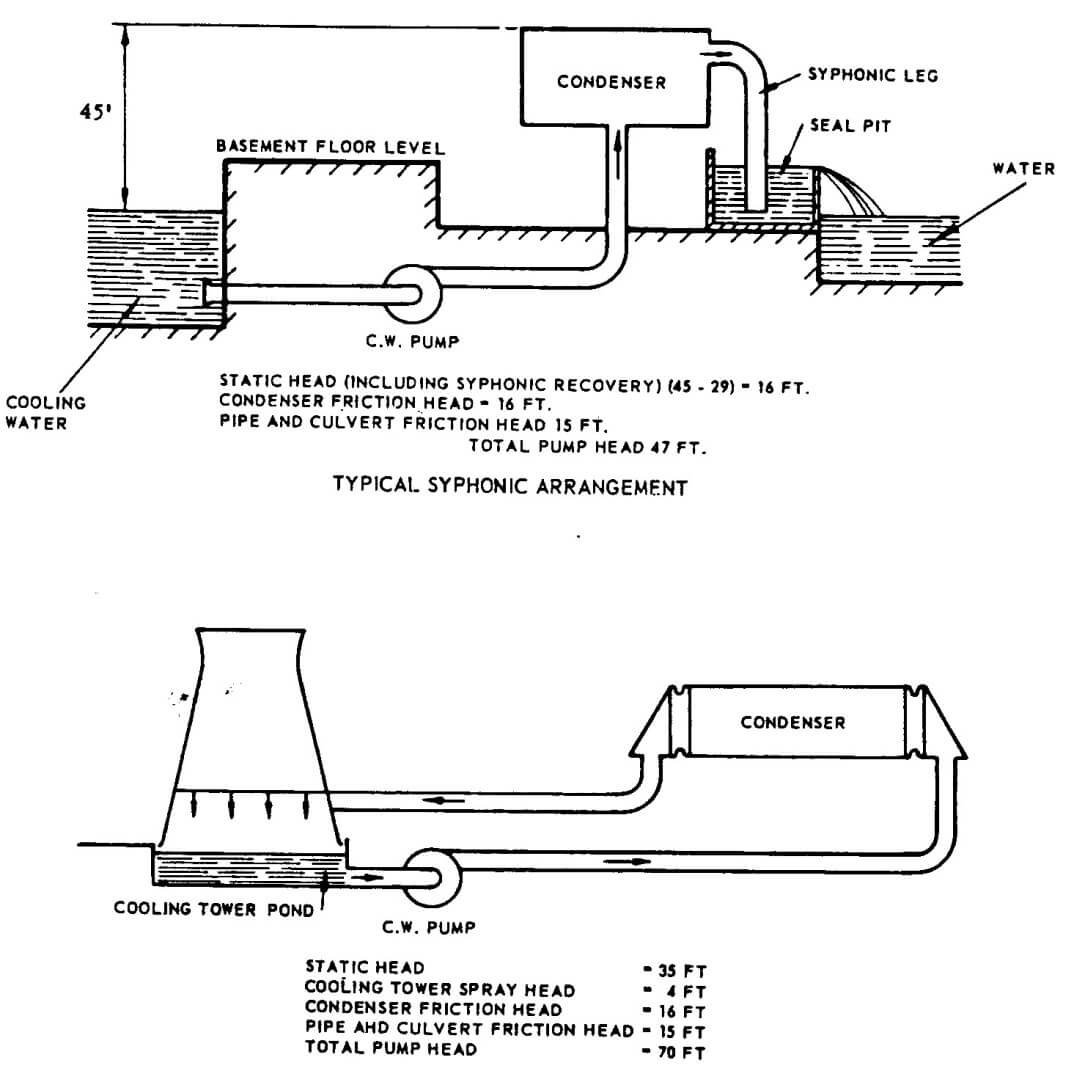
Berdasarkan siklusnya, terdapat 2 macam sistem air pendingin utama yang lazim diterapkan di PLTU yaitu :
sistem siklus terbuka (once through)
sistem siklus tertutup (recirculation – cooling tower).
Pada umumnya sistem air pendingin utama terdiri dari komponen :
Intake (untuk sistem air pendingin siklus terbuka)
Saringan (screen)
Pompa (cooling water pump – CWP)
Katup dan Pemipaan (piping)
Menara pendingin (cooling tower)
Untuk sistem air pendingin siklus
terbuka tidak dilengkapi dengan menara pendingin (cooling tower),
sebaliknya pada sistem siklus tertutup (resirkulsi) tidak dibutuhkan
intake yang dipasangi saringan-saringan, cukup dengan satu saringan
sederhana.
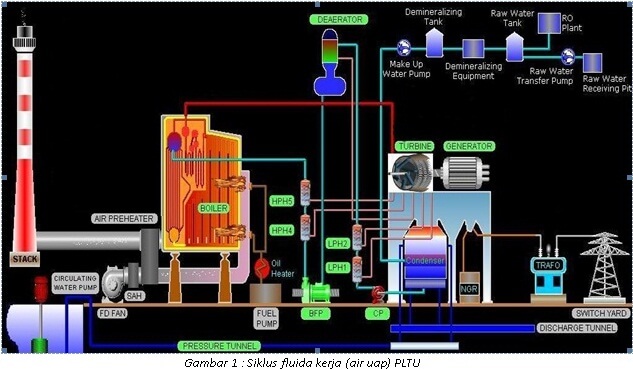
Siklus fluida kerja PLTU merupakan
siklus tertutup, yaitu menggunakan fluida yang sama secara
berulang-ulang. Siklus fluida kerja PLTU dijelaskan pada penjelasan
berikut ini. Pertama air diisikan ke boiler
hingga mengisi seluruh luas permukaan pemindah panas. Didalam boiler
air ini dipanaskan dengan gas panas hasil pembakaran bahan bakar dengan
udara sehingga berubah menjadi uap. Uap hasil produksi boiler masih berupa uap jenuh, kemudian dipanaskan lagi menggunakan superheater sehingga menjadi uap kering yang kemudian dengan tekanan dan temperatur tertentu diarahkan untuk melakukan kerja di turbin sehingga menghasilkan daya mekanik berupa putaran.
Uap bekas keluar turbin masuk ke Kondensor untuk didinginkan dengan air pendingin berupa air laut yang di pompa menggunakan pompa CWP (Circulation Water Pump) agar berubah menjadi air melalui proses kondensasi. Air kondensat
ini kemudian dipanaskan lagi secara bertahap menggunakan Heater/pemanas
menggunakan uap ekstraksi melalu LPH1, LPH2, Daerator, HPH4 dan HPH5.
Air demin tersebut digunakan lagi sebagai air pengisi boiler. Demikian
siklus ini berlangsung terus menerus dan berulang-ulang. Gambar 1
menunjukkan diagram siklus tertutup fluida kerja PLTU.
Hukum II Termodinamikaadalah
ekspresi dari kecenderungan yang dari waktu ke waktu, perbedaan suhu,
tekanan, dan menyeimbangkan potensi kimia dalam terisolasisistem fisik.
Semua proses yang terjadi secara alami hanya berlangsung pada satu arah
saja tapi tidak dapat berlangsung pada arah sebaliknya (biasa disebut
sebagai proses ireversibel alias tidak dapat balik).
Salah seorang ilmuwan yang bernama R. J. E. Clausius
(1822-1888) membuat sebuah pernyataan berikut : "Kalor berpindah dengan sendirinya dari benda bersuhu tinggi ke benda
bersuhu rendah; kalor tidak akan berpindah dengan sendirinya dari benda
bersuhu rendah ke benda bersuhu tinggi (Hukum kedua termodinamika –
pernyataan Clausius)"
Pernyataan Hukum II Termodinamika
Jika tidak ada kerja dari luar, panas tidak dapat merambat secara spontan dari suhu rendah ke suhu tinggi (Clausius)
Proses
perubahan kerja menjadi panas merupakan proses irreversible jika
tidak terjadi proses lainnya (Thomson-Kelvin-Planck)
Suatu
mesin tidak mungkin bekerja dengan hanya mengambil energi dari
suatu sumber suhu tinggi kemudian membuangnya ke sumber panas
tersebut untuk menghasilkan kerja abadi (Ketidakmungkinan mesin
abadi)
Mesin Carnot adalah salah satu mesin reversible yang menghasilkan daya paling ideal.Mesin ideal memiliki efisiensi maksimum yang mungkin dicapai secara teoritis
MESIN KALOR
Gagasan dasar dibalik penggunaan mesin kalor
adalah bahwa kalor bisa diubah menjadi energi mekanik hanya jika kalor
dibiarkan mengalir dari tempat bersuhu tinggi menuju tempat bersuhu
rendah. Selama proses ini, sebagian kalor diubah menjadi energi mekanik
(sebagian kalor digunakan untuk melakukan kerja), sebagian kalor
dibuang pada tempat yang bersuhu rendah. Proses perubahan bentuk energi
dan perpindahan energi pada mesin kalor tampak seperti diagram di
bawah…
Amati
diagram di atas… Suhu tinggi (TH) dan suhu rendah (TL) dikenal juga
dengan julukan suhu operasi mesin (suhu = temperatur). Kalor yang
mengalir dari tempat bersuhu tinggi diberi simbol QH, sedangkan kalor
yang dibuang ke tempat bersuhu rendah diberi simbol QL. Ketika mengalir
dari tempat bersuhu tinggi menuju tempat bersuhu rendah, sebagian QH
diubah menjadi energi mekanik (digunakan untuk melakukan kerja/W),
sebagian lagi dibuang sebagai QL. Sebenarnya kita sangat mengharapkan
bahwa semua QH bisa diubah menjadi W, tapi pengalaman sehari-hari
menunjukkan bahwa hal tersebut tidak mungkin terjadi. Selalu saja ada
kalor yang terbuang. Dengan demikian, berdasarkan kekekalan energi, bisa
disimpulkan bahwa QH = W + QL.
The Carnot's cycle was proposed by Sadi Carnot (1796-1832), who is considered
to be the founder of thermodynamics. The cycle describes a sequence of steps
that can be performed only in an ideal engine, which transforms heat into
work. The Cycle was a culmination of the research done by Carnot in thermodynamics.
By the end of the eighteenth century, many engineers were doing experiments
on engines used to perform especialized work, using heat as the source of
energy. For example, many engines were designed using as source or energy
the heat produced by combustion of coal or wood.
A common goal of all those engineers were to create machines that could be
as effcient as possible in using the heat provided. Based on the study of
these machines, Carnot discovered the cycle as an ideal model, and demonstrated
that this could not be improved.
Phases of the Carnot's Cycle
A diagram of the Carnot's Cycle is shown in the figure down there. The sequence
of steps in the Carnot's
cycle are the following:
² Adiabatic compression from temperature T1 to T2, where T2 < T1;
² Isothermal expansion at the temperature T1
² Adiabatic expansion to T2
² Isothermal compression
We describe each of these phases of the cycle next.
Adiabatic compression/expansion
The first phase of Carnot's cycle consists of an adiabatic compression of
the material in the engine. An adiabatic transformation is one in which no
heat is gained or lost. In this kind of process, the energy is conserved inside
the boundaries of the system. This condition can be described in mathematical
therms as dQ = 0;
where Q is the variable representing the amount of heat in the system.
However, according to the first law of thermodynamics,
dE = dQ-dW;
i.e., the variation of internal energy is equal to the variation of temperature
minus the
variation of work done by the system. Therefore
dE = -dW = -pdV;
where V is the volume of the system. Thus, to have an adiabatic process we
must have change in volume of the system.
A diagram of the Carnot's Cycle, with a measure of its eficiency.
Acordingly, the first phase of the Carnot's Cycle is defined by a change in
volume of the system. This change is made in such a way that energy is transformed
from heat into movement, and that will result in the change of volume. The
temperature in the system, consequently, changes from T1 to T2.
However, the process of changing heat into work cannot be done indefinitely,
due to restrictions from the 2nd law of thermodynamics. This implies that
the system will at some point loose e±ciency, and heat energy cannot
be further transformed into work.
Isothermal expansion/compression
These two phase are complementary to the phases described above. An isothermal
process is one in which the temperature remains constant. To have expansion,
or compression at isothermal conditions, some energy must exchanged with other
systems, and therefore work can be done.
In the second phase of the Carnot's cycle, the system will expand at a the
same temperature. This will promote the transformation of energy from heat
to a mechanical form. It is important to mention that this process is not
reversible, and it is there that the limitation is, acording to the 2nd law
of thermodynamics.
The last phase of the Carnot's cycle is similar, but here a contraction is
done, instead of an expansion. This makes the system go back to the same state
it was at the beginning of the cycle, and a new cycle can start.
Importance of the Carnot's Cycle
The Carnot's cycle is important since it describes an optimal system, where
heat energy is used at its best. However, it has consequences beyond the simple
study of engines. It can be also used to describe theoretical limits of the
transformation of heat into physical work. In this sense it is applicable
not only to mechanical models, but also to other kinds of energy.
One of the consequences of the second law of thermodynamics is that heat cannot
be transformed completely in work. Heat is a type of energy that has high
entropy. Acording to the 2nd law of thermodynamics, entropy in a system can
only increase with time. Thus, this gives a limit on the amount of energy
that can be tranfered from heat to work.
Carnot's cycle is a physical expression of the consequence of the 2nd law
of thermodynamics for engines and other related physical systems. It quanti¯es
the loss of energy that must occur whenever we try to convert heat into other
types of physical energy.
Pengertian sistem termodinamika berbeda dengan pengertian sistem pada umumnya. Untuk lebih jelasnya perhatikan uraian berikut !
1. Pengertian Sistem dalam Termodinamika
Benda atau objek yang diteliti atau dan menjadi pusat perhatian disebut sistem.
Sedangkan benda yang berada di luar sistem disebut lingkungan. Batas
diartikan sebagai perantara antara lingkungan dengan sistem. Semesta
adalah tempat dimana sistem dan lingkungannya berada.
sistem dalam termodinamika
2. Macam – macam Sistem Termodinamika
Sistem dalam termodinamika dibedakan enjadi 3, yaitu : a. Sistem termodinamika terbuka
Disebut sistem terbuka jika ada pertukaran energi dan zat antara sistem
dengan lingkungan. Pada sistem terbuka massa maupun energi melintasi
batas dan bersifat permeabel. Sistem terbuka juga disebut control volume
karena pada sistem terbuka volume sistem tetap.
Pada sistem terbuka berlaku perjanjian sebagai berikut :
1. Panas (Q) bernilai negatif jika keluar sistem dan bernilai posiif jika masuk sistem
2. Usaha (W) bernilai negatif jika keluar sistem dan bernilai positif jika masuk sistem.
b. Sistem termodinamika tertutup
Disebut sistem tertutup jika ada
pertukaran energi tetapi
tidak terjadi pertukaran zat dari sistem ke lingkungan. Pada sistem
tertutup energi dapat melewati batas tetapi zat tidak dapat melewati
batas sistem dan lingkungan. Pada sistem tertutup terjadi perubahan
volume karena adanya lapisan batas yang bergerak.
Suatu sistem tertutup memilki pembatas. Pembatas pada sistem tertutup dibedakan menjadi :
Pembatas adiabatik : tidak terjadi pertukaran energi panas.
Pembatas rigid: tidak terjadi pertukaran kerja.
Sistem tertutup juga memiliki dinding, yang dibedakan menjadi :
a. Dinding adiabatik merupakan dinding yang menyebabkan kedua zat
akan mencapai suhu yang sama dalam waktu yang lama. Pada dinding
adiabatik sempurna tidak ada pertukaran energi kalor antara kedua zat
b. Dinding diatermik merupakan dinding yang menyebabkan kedua zat akan mencapai suhu yang sama dalam waktu yang cepat.
c. Sistem termodinamika terisolasi
Dikatakan sistem terisolasi jika tidak ada pertukaran energi dan
pertukran zat antara sistem dan lingkungannya. Tetapi pada kenyattannya
tdak ada sistem yang terisolasi secara sempurna dengan lingkungannya.
Pada sistem terisolasi energ yang masuk sistem sama dengan energi yang
keluar sistem.
Karakteristik sistem termodinamika :
Karakteristik sebuah sistem termodinamika dipengaruhi oleh koordinat sistem, yang terdiri dari :
1. Tekanan
2. Temperatur
3. Volume
4. Massa
5. Viskositas
6. Konduksi panas
Suatu sistem termodinamika dikatakan berada dalam kondisi state
atau koordinat tetap jika setiap jenis koordinat sistem dapat diukur
pada semua bagian dan hasilnya sama. Sedangkan sistem dikatakan
mengalami perubahan koordinat jika salah satu atau lebih jenis koordinat
sistem mengalami perubahan. Sistem dikatakan dalam keadaan seimbang
atau equilibrium jika sistem dalam keadaan tetap tidak berubah.
Artikel ini adalah suplemen dari artikel Wujud Zat Kelima, membahas sedikit detil tentang konsep perubahan fase. Cocok untuk siswa SMA dan sederajat, terutama yang masih bingung dengan “asas Black”, hehe. Kata kunci pada perubahan fase sebuah zat adalah “panas zat berubah, tapi temperaturnya tetap“.
Pada artikel Wujud Zat Kelima,
disinggung konsep “perubahan fase”. Secara harfiah, perubahan fase
terjadi saat sebuah zat berubah dari satu wujud ke wujud yang lain.
Misalnya dari gas ke cair, cair ke padat, padat ke gas, dan sebaliknya.
Proses-proses perubahan fase diilustrasikan oleh Gambar Proses perubahan fase zat (baca artikel Wujud Zat Kelima).
Setiap proses melibatkan panas, baik panas itu dilepas oleh zat ataupun
diterima oleh zat, tapi tidak melibatkan perubahan temperatur!
Proses Pendidihan dan Penguapan
Fenomena ini mungkin jarang kita amati, atau bahkan sebagian kita
merasa ini adalah hil yang mustahal. Kenapa? Karena perubahan
temperatur, normalnya, mengindikasikan perubahan panas. Semakin tinggi
temperatur sebuah zat, semakin panas juga dia. Untuk menaikkan
temperatur sebuah zat, kita dapat memanaskan zat tersebut. Sebaliknya,
untuk mendinginkan sebuah zat, maka sebagian panasnya harus dibuang
sehingga pada akhirnya temperaturnya berkurang. Kulkas, atau
refrigerator, adalah piranti umum yang dapat mengambil panas suatu zat
dan dibuang ke lingkungan. Oleh karena itu bagian belakang kulkas panas
dan bisa dipakai untuk mengeringkan pakaian — ini termasuk ide daur
ulang energi yang cerdas menurut saya. Air tepat mendidih: gelembung-gelembung udara pecah di dalam air sebelum sampai ke permukaan.
Namun sebenarnya tidak selalu demikian. Misalnya kita ingin
menguapkan sejumlah air. Ketika tepat mendidih (biasanya pada temperatur
100°celcius), kita tetap memberikan panas (misalnya panas api dari
kompor) supaya dia benar-benar mendidih. Tanda air tepat mendidih adalah muncul gelembung-gelembung udara dari dasar panci namun gelembung itu meletus di dalam air
sehingga terdengar bunyi mendesis. Jika kita matikan kompor saat itu,
maka gelembung-gelembung tersebut langsung hilang. Kejadian Ini
menandakan temperatur air turun. Air telah mendidih: terlihat gelembung-gelembung udara berhasil mencapai permukaan air.
Jadi kompor tetap dinyalakan (untuk memberikan panas pada air).
Gelembung-gelembung terus bermunculan dan terlihat mereka seakan-akan
berjuang untuk dapat sampai ke permukaan air. Pada saat ini, meskipun
air terus menerima panas, tapi temperaturnya tidak berubah, tetap
100°celcius. Kita bisa uji ini dengan cara meletakkan termometer ke
dalam air selama proses pendidihan berlangsung. Jika gelembung-gelembung udara tersebut berhasil sampai di permukaan air, maka disebut air telah mendidih
— sebagian air (zat cair) telah berubah menjadi uap (gas). Ambil
termometer lain dan coba ukur temperatur gas yang berada tepat di atas
permukaan air — nilainya pasti sama atau lebih tinggi dari 100°celcius.
Pada kondisi ini, panas yang diterima uap air dipakai untuk menaikkan
temperaturnya — kondisi kembali normal.
Kalor dan Kalor Laten
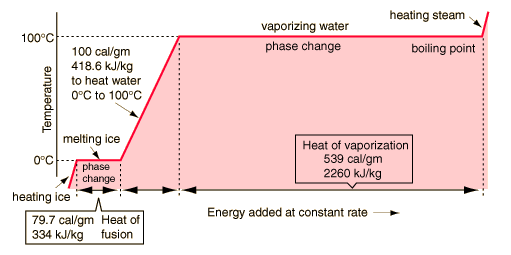
Diagram temperatur-energi panas (T-Q) pada perubahan fase wujud zat.
Cerita ini digambarkan oleh diagram temperatur-energi perubahan fase.
Istilah “panas” yang sering kita ucapkan sehari-hari adalah energi yang
dipakai untuk mengubah temperatur zat — disebut juga dengan istilah
kalor. Nilainya diberikan oleh
.
dengan adalah panas yang terlibat (diterima atau dilepaskan zat, satuan joule (J)), adalah massa zat (kg), adalah kalor jenis (J/kg.K), dan adalah perubahan temperatur yang dialami oleh zat (K, kelvin).
Ada konsep baru yang disebut di sini, yaitu kalor jenis.
Kalor jenis adalah jumlah panas yang dibutuhkan untuk menaikkan
temperatur satu kilogram zat sebanyak 1 K (atau setara dengan 1°celcius)
— ini sesuai dengan satuannya J/kg.K. Setiap zat memiliki nilai yang berbeda-beda. Air misalnya, memiliki nilai J/kg.K.
Oke, kita lanjut. Bagaimana dengan panas yang terlibat selama proses perubahan fase? Panas ini disebut panas laten atau kalor laten. Istilah “laten” berasal dari bahasa Inggris, “latent“,
yang berarti “tersembunyi”. Zaman orba dulu, istilah laten sering
dipakai untuk mencap paham komunis sebagai bahaya laten. artinya paham
ini adalah bahaya yang tidak terlihat tapi sesungguhnya adalah bahaya.
Ini seperti api dalam sekam, apinya tidak terlihat dari luar tapi
sesungguhnya dia ada di sana.
Kalor laten, dalam termodinamika, dirumuskan sebagai
dengan adalah kalor laten, adalah massa zat, dan adalah kalor jenis laten (J/kg).
Penggunakan Diagram T-Q
Salah satu penggunaan diagram T-Q adalah
menghitung panas yang terlibat selama proses perubahan fase berlangsung.
Gambar di bawah ini contoh diagram T-Q untuk air (wujud padat, cair,
dan gas). Misalnya, untuk mencairkan es butuh 334 kJ panas (kalor
laten). Untuk mendidihkannya butuh 418,6 kJ panas. Untuk menguapkannya,
butuh 2260 kJ (kalor laten). Jadi, setidak-tidaknya butuh 3012,6
kilojoule panas! Nilai ini akan bertambah jika temperatur es di bawah
0°celcius
Penggunaan lain adalah untuk menganalisis prinsip asas Black yang sering diuji di sekolah. Bagaimanakah itu? Tunggu artikel berikutnya, karena saya sekarang harus pergi dulu.






 .
. adalah panas yang terlibat (diterima atau dilepaskan zat, satuan joule (J)),
  adalah massa zat (kg),
  adalah kalor jenis (J/kg.K), dan
  adalah perubahan temperatur yang dialami oleh zat (K, kelvin).
 J/kg.K.
 adalah kalor laten,
  adalah kalor jenis laten (J/kg).